I had been having such a blast AT skiing that it was late March by the time I realized I hadn’t done any winter mountaineering. The winter had been good this year and while the pure ice climbing was long gone, I reasoned that there should still be some nice spring snow in the upper reaches of the Whites.
I knew that I wouldn’t have a partner down for such an endeavor. This meant I would need to keep the technical difficulty low and also look for an ideal window of weather and avalanche conditions.
Two objectives had been on my mind, The central gully in Huntington Ravine and the north slide of North Tripyramid.
I drew up the routes in CalTopo and started checking the forecast daily. A couple weekends passed that didn’t quite work out until one Saturday evening as I was contemplating my planned rainy/muddy trail run the next morning, I took a peak at the forecast. Things looked good! It was 10 pm but my mind was made up, to the mountains.
Knowing that I would be getting a late start the next day, I decided on the N. Tripyramid slide. It would be a significantly shorter drive, on a cold NW aspect, and I suspected less likely to be undermined by flowing melt water due to it’s topography.
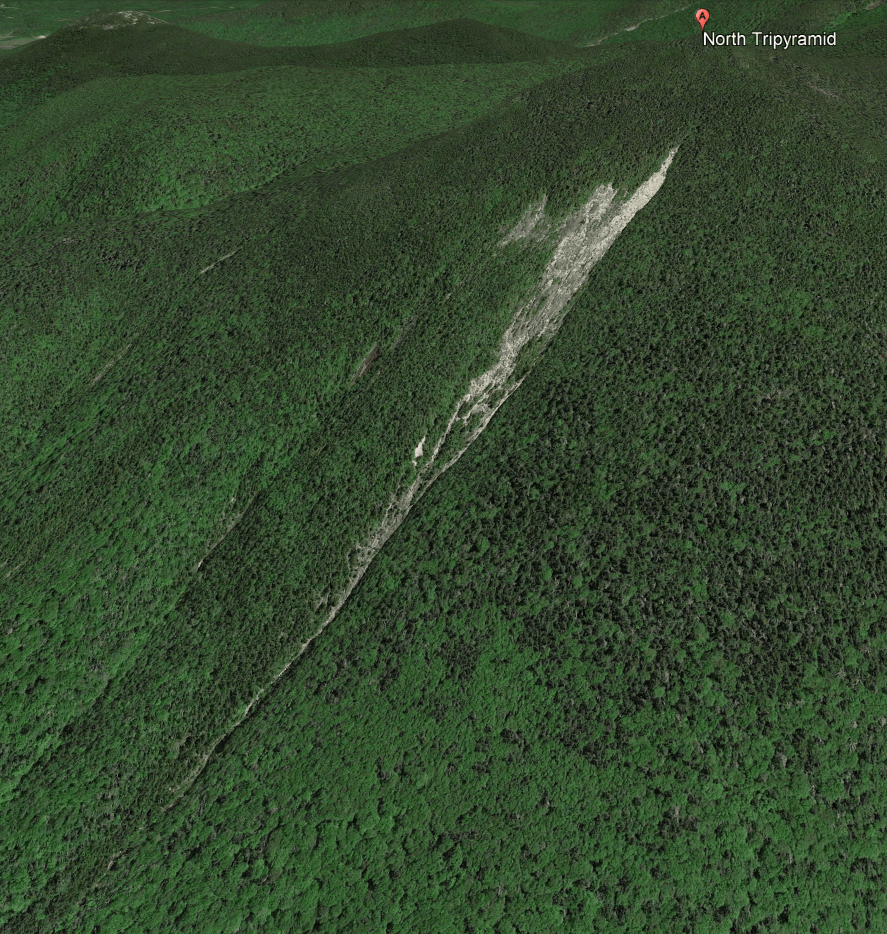
Main slide on the NW face of North Tripyramid
The Tripyramid slides in the Sandwich Range are likely not so well known. Such “slides” can be found throughout the region; they are essentially large land slide scars where the topsoil has eroded down to the underlying rock slab. This particular feature rises ~1300 ft at an angle of 30-35° and constitutes one of New Hampshire’s “Terrifying 25” .
To ensure a full value experience I would approach from the Rt. 112 side, taking the Pine Bend Brook Trail and ascending to the col with Scaur peak. From here I would descend toward Waterville Valley before crossing Avalanche brook and making my way up the slide. My descent path would follow the Tripyramid ridge down to the col then back out the trail.
I was planning on a substantial approach followed by fairly moderate snow climbing with temps around 0°C and light winds. There was a chance of light snow/rain in the afternoon, but overall conditions looked excellent.
Gearing up while inhaling a bagel and coffee, I loaded a 30L alpine pack with basic survival gear, beacon/shovel/probe, extra clothing, a liter of water, and 400 cal of gels. For tools I decided on poles, a glacier/traditional ice axe, and aluminum crampons.
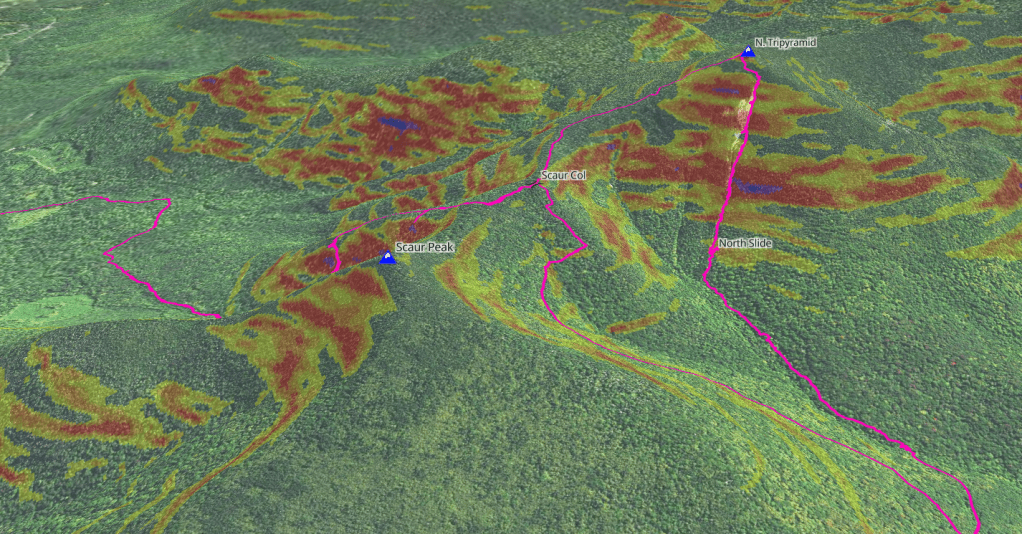
North Tripyramid via N. Slide – 8 hr, 10.2 mi, 4000 ft ascent
The approach started out well, the trail climbing gently and crossing several small streams. I found that skiing has taught me a lot about planning “transitions” along my route and stopping efficiently.
I encountered some people on the trail, most of whom seemed to be having a good time. The snow was packed down to an icy monorail making for some tricky sections just below the Scaur col. Making my way down the XC ski trail toward Waterville Valley brought the warm sun and a renewed sense of purpose.
As the peak came into view I could look up and see the white streak reaching through the trees toward the summit. From there, it looked impossibly steep but I was feeling pretty stoked.
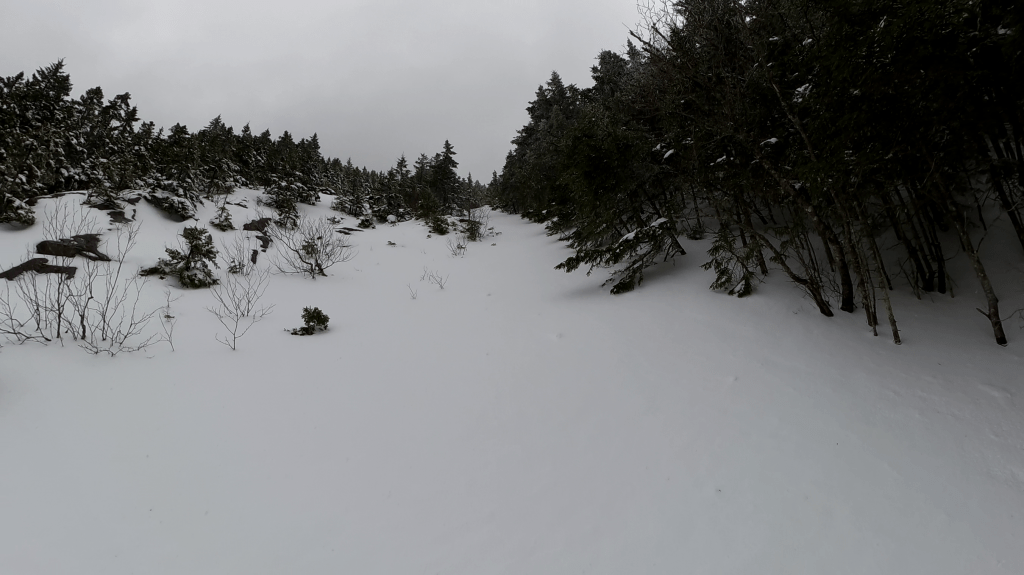
Spring snow on the N. Tripyramid slide
As I crossed Avalanche Brook it was clear that no one had been this way except maybe some keen skiers earlier in the season. The snow felt good as I was breaking trail up into the slide and the angle started to started to steepen. I would periodically dig with a hand into the snow 20 – 30 CM deep, feeling around for weak layers or slabs. At lower elevation things were nicely homogeneous with a shallow 1F windslab appearing near the top of the slide. Thankfully it didn’t seem reactive.
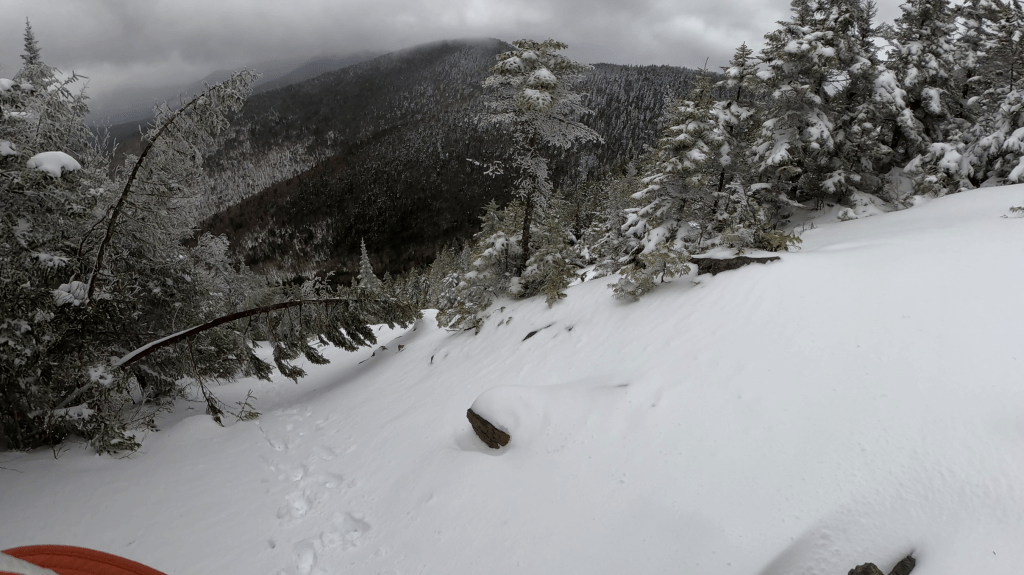
Approximately mid-way up the slide
Looking out on to the other other Sandwich Range peaks and just kicking snow steps felt great. I was feeling pleased with my fitness and well in control. As I neared the upper half of the slide, though, things started to get a bit more full-on.
At one point I started to kick another step and realized I was dealing with more like < 10 cm of snow on top of the rock slab. My heart sank a bit and I remember thinking “huh, this might shut me down”. At the same time, I knew that some mixed moves might be required going into this. I kicked a good step in the snow below then placed a crampon up on the slab and gently pushed myself up on it. I almost couldn’t believe it was working, that I was actually able to do it.
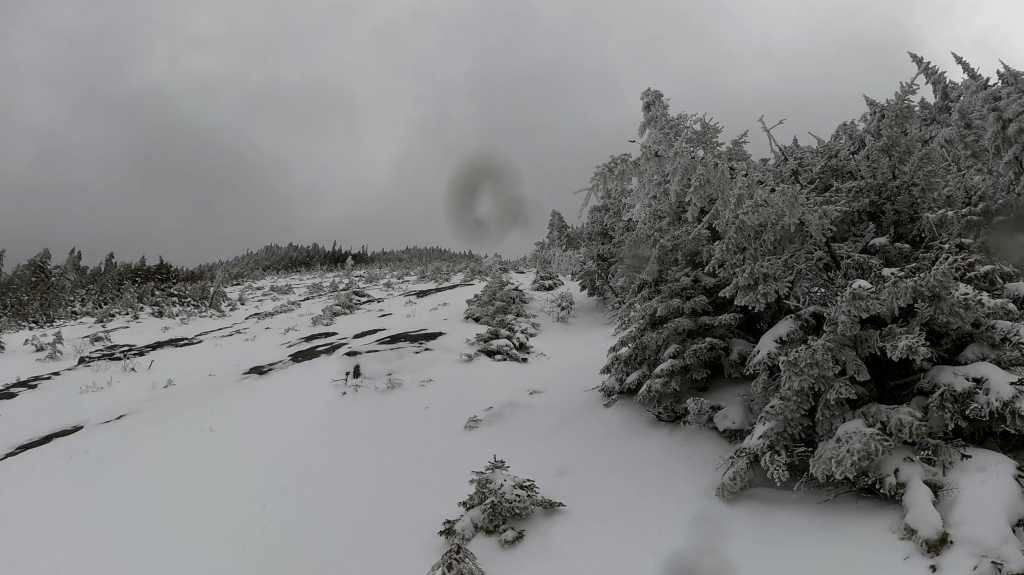
Mixed conditions high on the slide
Pushing on, I would try to stick to the snow as much as I could but the rock was unavoidable. The moves were manageable and it still made sense to continue upward in any event.
Because of the extended approach and descent, I had decided on light “skimo style” crampons with dyneema linking strands. These had been awesome on my ski boots and I had set them up for my mountain boots that morning. They had been fine on the approach, but a combination of snow botting and more intense use caused one to pop off. I managed to get it back on but couldn’t re-adjust it tighter under the circumstances. Important lesson here about testing new systems !
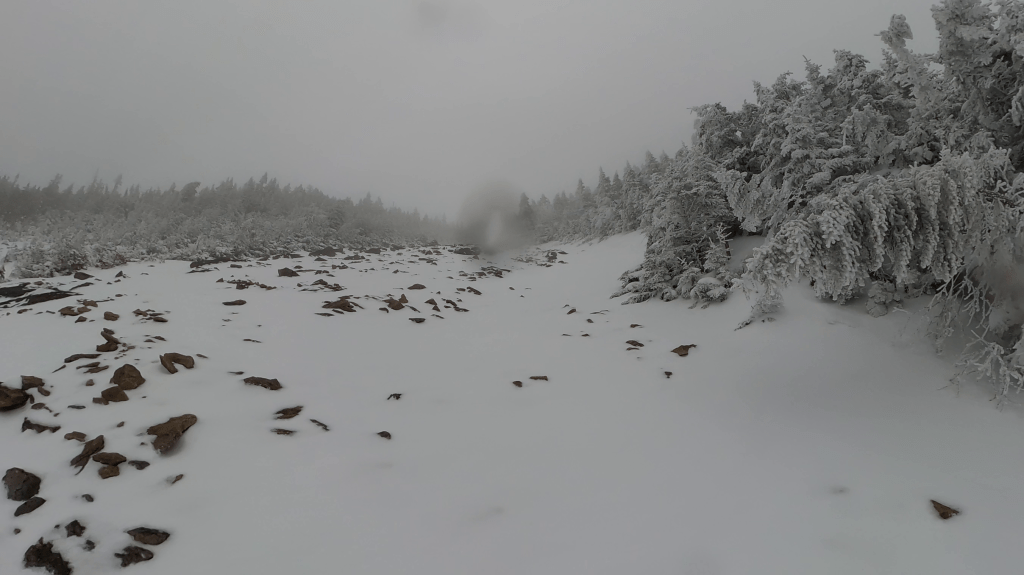
Choosing my line to the top of the slide
As I reached the top of the slide, visibility was starting to get poor with intermittent sleet/rain. I kept moving up into the trackless snow drifted forest around the summit and eventually popped out into a small clearing where 3 trails intersected.
This was it, some random trail intersection in the middle of the forest, the summit of North Tripyramid. I laughed out loud at the apparent absurdity. The journey is what counts.
I carefully pointed myself down the shoulder and started descending. While I don’t want to make a habit of traveling alone in avalanche terrain, it felt good knowing that I had managed to stack some factors in my favor and proceed in relative safety. Descent would continue by headlamp until I finally reached Rt. 112, the last vehicle in the parking lot.
 About me